



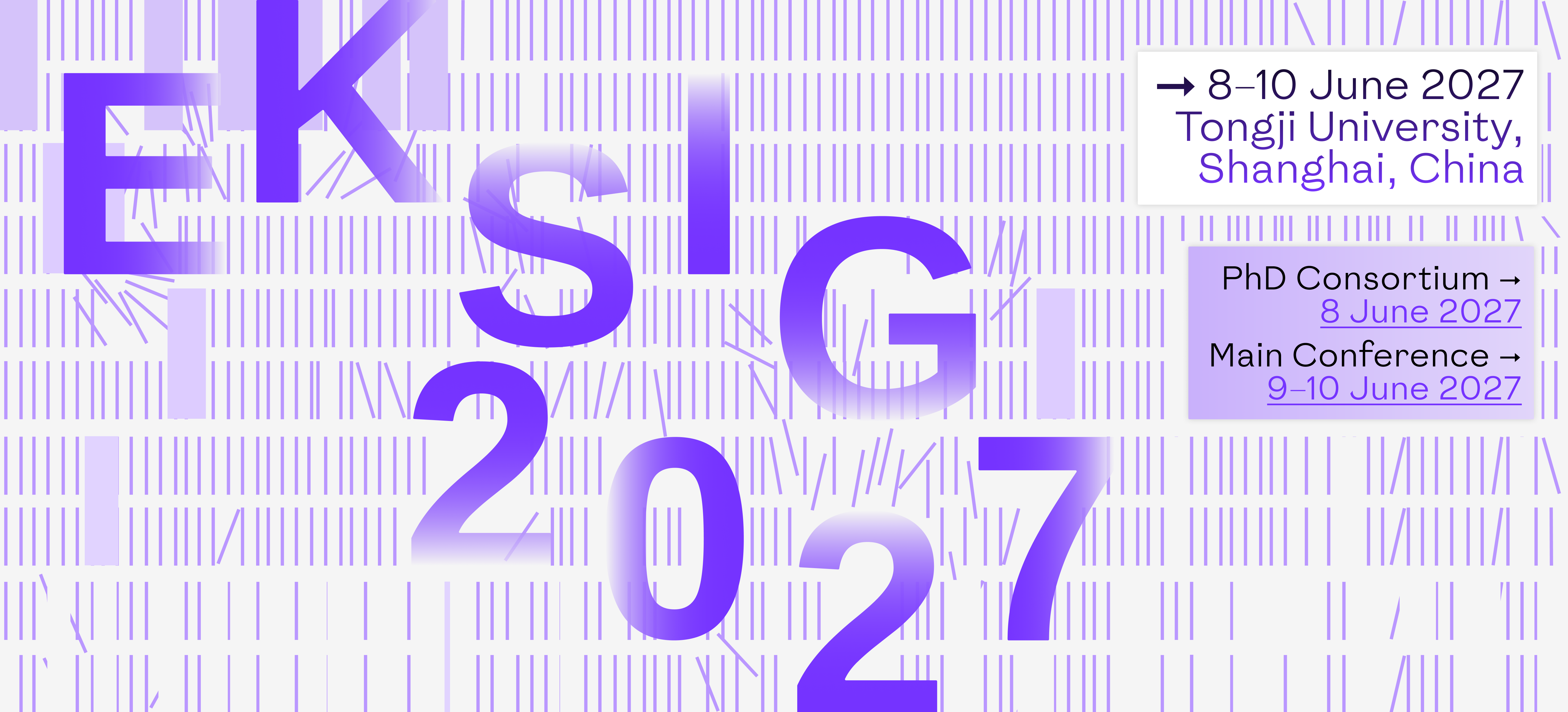
EKSIG 2027 invites researchers, creative practitioners, educators, technologists, doctoral researchers, and design professionals to explore how design methods and experiential knowledge are changing in the age of artificial intelligence.
Since its first conference in 2007, EKSIG has provided a focused international forum for research on experiential knowledge, tacit knowledge, embodied practice, material engagement, craft, making, research through design, and design methodology. EKSIG 2027 marks the twentieth anniversary of the conference series and will be the first EKSIG conference hosted in Asia.
This is a timely moment to ask how design knowing changes when
human experience is brought into relation with machine intelligence. 
Artificial intelligence is entering design practice not merely as an automation tool, but as a generative medium through which possibilities are proposed, compared, and reconfigured, while also introducing new uncertainties around intent, control, evaluation, and reflective design partnership1234. Yet design knowledge still depends on capacities that cannot be reduced to computation: human sensibility, embodied judgement, tacit skill, material engagement, imagination, responsibility, and situated interpretation56.
EKSIG 2027 approaches this condition as one of hybrid intelligence. Hybrid intelligence is not simply the use of AI as a tool. Rather, it describes a changing ecology of design knowing, where human and machine capacities are distributed, negotiated, and recombined across design processes7. In this context, the key question is how design knowledge changes when humans and machines begin to co-design.
Experiential knowledge has long been central to design research and practice, especially in research traditions that treat lived experience, reflection, tacit knowledge, and first-person inquiry as legitimate sources of design knowledge89. Because it is embodied, situated, affective, relational, and materially mediated, it is often difficult to fully translate into words5. AI introduces other forms of knowing: computational, statistical, generative, scalable, and often opaque111. The meeting of these forms creates both new possibilities and new tensions for design research, especially when generative AI begins to reshape how designers frame problems, produce alternatives, interpret outcomes, and communicate design knowledge4.
Rather than prescribing fixed positions or directions, EKSIG 2027 invites open, critical, multidisciplinary, and diverse inquiries into this evolving terrain. We welcome conceptual, methodological, empirical, material, technical, pedagogical, philosophical, performative, and speculative contributions. We especially welcome work that critically examines the changing nature of design knowledge, whether through AI and hybrid intelligence or through broader inquiries into experiential knowledge in design research, professional design, craft, and making practices.
- 1Bofylatos, S., & Spyrou, T. (2017). Meaning, knowledge and artifacts, giving a voice to tacit knowledge. The Design Journal, 20(sup1), S4422–S4433. https://doi.org/10.1080/14606925.2017.1352938
- 2Burrell, J. (2016). How the machine "thinks": Understanding opacity in machine learning algorithms. Big Data & Society, 3(1), 1–12. https://doi.org/10.1177/2053951715622512
- 3Choudhury, M. M., Eisenbart, B., & Kuys, B. (2025). Artificial intelligence (AI) in the design process: A review and analysis on generative AI perspectives. Proceedings of the Design Society, 5, 631–640. https://doi.org/10.1017/pds.2025.10077
- 4Dellermann, D., Ebel, P., Söllner, M., & Leimeister, J. M. (2019). Hybrid intelligence. Business & Information Systems Engineering, 61(5), 637–643. https://doi.org/10.1007/s12599-019-00595-2
- 5Lou, Y. (2023). Human creativity in the AIGC era. She Ji: The Journal of Design, Economics, and Innovation, 9(4), 541–552. https://doi.org/10.1016/j.sheji.2024.02.002
- 6Niedderer, K., & Reilly, L. (2010). Research practice in art and design: Experiential knowledge and organized inquiry. Journal of Research Practice, 6(2), Article E2.
- 7Nimkulrat, N., & Groth, C. (Eds.). (2024). Craft and design practice seen from an embodied perspective. Routledge. https://doi.org/10.4324/9781003328018
- 8van der Burg, V., de Boer, G., Salah, A. A. A., Chandrasegaran, S., & Lloyd, P. (2023). Objective portrait: A practice-based inquiry to explore AI as a reflective design partner. In Proceedings of the 2023 ACM Designing Interactive Systems Conference. Association for Computing Machinery. https://doi.org/10.1145/3563657.3595974
- 9van der Maden, W., van der Burg, V., Halperin, B. A., Jääskeläinen, P., Lindley, J., Lomas, D., & Merritt, T. (2025). When discourse stalls: Moving past five semantic stopsigns about generative AI in design research. arXiv. https://doi.org/10.48550/arXiv.2503.08565
- 10Xue, H., Desmet, P. M. A., & Yoon, J. (2024). On the cultivation of designers' emotional connoisseurship, part 1: A theoretical positioning. She Ji: The Journal of Design, Economics, and Innovation, 10(1), 9–31. https://doi.org/10.1016/j.sheji.2024.03.001

To keep the call clear while supporting diverse forms of knowledge, EKSIG 2027 welcomes four submission types for conference contributions.
- 1.Full research papers🡥
- 2.Practice-based contributions🡥
- 3.Workshop proposals🡥
- 4.PhD consortium participation🡥
→ Authors and proposers should choose the format that best fits how their contribution is produced, communicated, and experienced.
Full research papers present original scholarly contributions through written argument. They may include theoretical development, methodological inquiry, empirical research, research through design, pedagogical reflection, critical analysis, or practice-based research articulated through text.
Full papers should:
- Present a clear research question, aim, or problem;
- Situate the work in a relevant research context, through literature reviews, practice-led benchmarking, or related theoretical discourse;
- Explain the research design, method, case, material, or theoretical approach;
- Articulate the contribution to research methodology or design methods, experiential knowledge, hybrid intelligence, or design and crafts research more broadly;
- Provide sufficient evidence, analysis, examples, or reflection to support the argument.

- Suggested length: 4,000–6,000 words, excluding abstract, references and figure captions.
- Review: Double-blind peer review.
- Publication: Accepted papers will be published in the EKSIG 2027 conference proceedings, hosted in the DRS Digital Library, subject to final submission and registration.
- Presentation: Accepted papers may be presented through talks, discussion-based sessions, or other interactive formats.
Practice-based contributions are intended for work where the knowledge contribution is produced, communicated, or tested through practice, and cannot be fully expressed through text alone.
This category typically includes:
- Video articles;
- Interactive demos or artefacts, including prototypes, AI tools, or systems;
- Installations or material experiments;
- Performances, including lecture-performances or embodied demonstrations;
- Situated or participatory inquiries;
Practice-based contributions have the same scholarly status as full research papers. They are not secondary formats, showcases, or documentation of completed work. Rather, they should make a clear research, methodological, theoretical, pedagogical, or practice-based contribution to the conference theme.
A practice-based contribution should explain:
- What research question, inquiry, or concern drives the work;
- What has been made, performed, demonstrated, tested, or explored;
- Why practice is necessary for producing or communicating this knowledge;
- How the work contributes to experiential knowledge, design methods, hybrid intelligence, or design research more broadly;
- How participants will encounter, view, interact with, or discuss the work;
- What space, time, equipment, material, technical, accessibility, or safety requirements are involved.
Practice-based submissions must also include a written paper and supporting material.
- Suggested written paper length: 2,500–5,000 words, excluding abstract, references and figure captions. The length of the paper depends on the nature of the contribution and the role of supporting multimedia material.
- Supporting material: images, video links, scripts, performance instructions or scores, storyboards, prototype documentation, technical descriptions, or other relevant material can be included in the written contribution as a link, if it is stored in a permanent database that will remain accessible over the long term.
- Review: Blind review of both the written paper and the supporting material.
- Publication: accepted written papers will be published in the EKSIG 2027 conference proceedings, hosted in the DRS Digital Library, subject to final submission and registration.
- Presentation: accepted contributions may be included in exhibitions, demos, performances, discussion sessions, or other formats agreed with the organisers.

Video articles use video as a primary scholarly medium. They are not recorded paper presentations. The video should carry an essential part of the argument, demonstration, documentation, or reflection, while the written paper provides the research framing, method, contribution, and relation to the conference theme. The video article is submitted as a written paper with a link to the video, and this video and any supporting material must be stored in a permanent repository to ensure long-term accessibility.

These contributions centre on direct engagement with a prototype, artefact, tool, AI system, installation, method, material set-up, or designed situation. The written paper should explain how interaction with the work generates, reveals, tests, or communicates design, craft, or experiential knowledge.
Because the contribution depends on interaction, submissions must include supporting documentation that enables reviewers to understand how the work is encountered and what kind of knowledge the interaction produces. This may include images, diagrams, screen recordings, short video walkthroughs, prototype links, technical descriptions, interaction scripts, or documentation of prior use.
Video documentation is expected when movement, timing, system behaviour, performance, or participant interaction is central to the contribution. Such documentation does not need to be production quality, and it does not make the submission a video article unless video itself is the primary scholarly medium.
Authors should also specify any space, equipment, material, technical, accessibility, or safety requirements needed for presenting the work at the conference.

Performance papers use performance as a mode of inquiry, communication, or knowledge generation. They may be live, recorded, participatory, lecture-based, material-based, or technology-mediated.
A performance paper may include video documentation, but it is not automatically a video article. If the video is the main scholarly medium, authors should frame the submission as a video article. If the performative act is central, authors should frame it as a performance paper. A version of the performance must be video recorded and submitted for peer review, but can be developed further for the actual on site performance during the conference.
EKSIG 2027 invites workshop proposals as part of this call. Workshops are active sessions for shared inquiry. They should not be conventional paper presentation sessions.
We welcome workshops that engage participants through making, discussion, experimentation, critique, reflection, demonstration, method development, or situated exploration of the conference theme. Workshops may address hybrid intelligence and AI-supported design, but they may also focus more broadly on experiential knowledge in design and craft research and professional practice, including investigation into materials, embodiment, performance, care, collaboration, pedagogy, and research through design.
Workshop proposals should specify:
- Title and aims;
- Relevance to EKSIG 2027 conference theme;
- Research questions that will be investigated;
- Intended participants and capacity;
- Format and planned activities;
- Duration;
- Expected contribution to the conference;
- Space, equipment, material, technical, accessibility, or safety needs;
- Expected outputs, such as documentation, shared reflections, research data, prototypes, methodological insights, or future publications.
Workshop organisers will be responsible for designing and facilitating the session, preparing required materials, and communicating logistical needs to the conference organisers in advance.
- Suggested proposal length: 1,000–1,500 words.
- Review: workshop proposals will be reviewed for relevance, clarity, feasibility, participant engagement, and contribution to the conference.
- Publication: accepted workshop proposals will be included in the conference proceedings.
The EKSIG 2027 PhD Consortium will take place on 8 June 2027, before the main conference. It is intended as a supportive forum for doctoral researchers working on experiential knowledge, design methods, practice-based research, research through design, hybrid intelligence, AI-supported design practice, craft, making, embodiment, material engagement, or related areas.
PhD Consortium participation is a mentoring and discussion format rather than a proceedings paper track. It does not require a full paper. Doctoral researchers will be invited to submit a short research statement.
PhD Consortium applications should specify:
- Name, affiliation, country, and contact information;
- Doctoral programme, supervisor(s), and current stage of the PhD;
- working title or topic of the doctoral research;
- A brief summary of the research, including its background, aim, question, approach, and expected contribution;
- How the research relates to EKSIG 2027;
- Two or three questions, challenges, or decisions the applicant would like to discuss during the consortium;
- Whether the applicant has also submitted, or will present, a paper, practice-based contribution, workshop, or other contribution at EKSIG 2027;
- Any specific support needs, such as feedback on method, theory, practice-based research, writing, supervision, publication, or career development.
Suggested length: 800–1,000 words.
Review: PhD Consortium applications will be reviewed by the organisers for relevance, clarity, stage of doctoral research, fit with the consortium, and available capacity.
Publication: PhD Consortium applications will not be published in the conference proceedings.
Participation is open to doctoral researchers attending EKSIG 2027. Places may be limited in order to ensure meaningful discussion and mentoring. Accepted PhD Consortium participants will be expected to register for the conference.
Choose the full research paper if the main contribution is developed primarily through written scholarly argument.
Choose the practice-based contribution if the main contribution is developed through documented practice, such as video, artefact, prototype, installation, AI system, material experiment, demonstration, performance, embodied enactment, or situated interaction. Practice-based contributions must include both a written paper and supporting material.
Choose the workshop proposal if the main aim is to organise and facilitate an active session for participants.
Choose the PhD Consortium participation if you are a doctoral researcher seeking focused feedback on ongoing research and wish to discuss your work with peers and senior researchers in the EKSIG community.
Where a submission could fit more than one category, choose the category that best reflects how the knowledge contribution is primarily produced, communicated, and shared.
EKSIG 2027 will be an in-person only conference.
-

We aim to create a conference that reflects the nature of EKSIG: rigorous, intimate, experimental, and grounded in experience. The programme will prioritise meaningful exchange over passive presentation.
-
Accepted contributions may be presented through talks, discussion-based sessions, exhibitions, demos, performances, facilitated conversations, or other interactive formats. Where appropriate, contributors may be invited after acceptance to prepare short video or visual material to support session preparation, chairing, archiving, or flipped discussion.
-
The number of accepted contributions will be limited to ensure quality, meaningful interaction, and a sense of community.
Submissions will be reviewed by an international review team.
Full research papers will be double-blind peer reviewed. Practice-based contributions will be blind reviewed on the basis of both the written paper and supporting material. Workshop proposals will be reviewed for relevance, clarity, feasibility, and contribution to the conference. PhD Consortium applications will be reviewed by the organisers for relevance, stage of doctoral research, fit with the consortium, and available capacity.
Submissions may be desk rejected if they are clearly outside the scope of the conference, fail to meet submission requirements, are not anonymised where required, exceed or fall significantly short of the specified length, lack scholarly or practice-based quality, or use AI-generated material without transparency.
Authors must declare significant use of AI tools in preparing the submission, including use in writing, analysis, image generation, video production, coding, data processing, design generation, prototyping, or evaluation.
AI use is allowed, but it must be transparent, accountable, ethical, and appropriate.
Accepted full papers and accepted written papers of practice-based contributions will be published in the EKSIG 2027 conference proceedings, hosted in the DRS Digital Library. Publication is subject to final acceptance, submission of a camera-ready version, and registration of at least one author for the conference.
After the conference, a selection of high-quality contributions may be invited for further development into an article for a special issue of She Ji: The Journal of Design, Economics, and Innovation. Approximately 8–12 contributions may be considered, depending on quality, fit, and editorial capacity. Invitation to the special issue does not guarantee publication. Selected authors will be asked to substantially develop their work after the conference and will undergo a separate journal review and revision process. The target publication date for the special issue is June 2028.
EKSIG 2027 will be hosted by Tongji University in Shanghai, China.
Further information about the venue, registration, accommodation, keynote speakers, templates, and submission platform will be announced on the conference website later (https://eksig2027.thedrs.org; to be soon online in Aug 2026).

Conference Chairs
- Haian Xue, Tongji University, China
- Jin Ma, Tongji University, China
Programme Committee
- Nithikul Nimkulrat, OCAD University, Canada
- Camilla Groth, Aalto University, Finland
- Spyros Bofylatos, Royal College of Art, England
- Ye Yang, Tongji University, China
- Runxi Wu, Tongji University, China
- Additional members to be confirmed.
Scientific Committee
- To be announced.
Get In Touch
The Experiential Knowledge Special Interest Group of the Design Research Society is concerned with the role of experiential knowledge in design research and professional practice (see previous conferences and more information here: https://eksig.org/).
EKSIG brings together researchers and practitioners who investigate how knowledge is generated, shared, questioned, and transformed through designing, making, reflecting, sensing, performing, and engaging with materials, people, technologies, and situations.
EKSIG 2027 continues this tradition by asking what becomes of experiential knowledge when intelligence itself becomes hybrid.